Wood pellet calorific value: how much energy is in a kilo?
Wood pellet calorific value: accurate kWh, MJ and kcal per kg, ENplus grade comparisons and bulk buying guidance for UK and European buyers.
When you pay for fuel by the tonne, the one number that matters most is calorific value. It tells you exactly how much heat is packed into every kilogram you buy. Get it right, and your heating bills shrink. Get it wrong, and you are essentially paying for weight rather than warmth.
The wood pellet calorific value is at least 16.5 MJ per kilogram under ENplus A1 and EN ISO 17225-2, equal to about 4.6 kWh or 3,940 kcal per kilogram. Those are the certified minimums. In practice, the pellets we supply at Cambridgeshire Straw Pellets Limited consistently perform above that floor, giving our customers better-than-minimum returns on every tonne ordered.
What is wood pellet calorific value?
Wood pellet calorific value is the heat released when one kilogram of pellets burns completely, expressed in kWh, MJ, or kcal.
Calorific value is an indicator of wood pellet quality. It means the amount of heat released by a unit mass (or volume) of fuel in full combustion. The calorific value of wood pellets refers to the heat released by 1 kg of wood pellets.
There are two versions of this figure worth knowing:
- Net calorific value (NCV): The realistic, usable heat output once water vapour escapes through the flue. This is the heat actually available when the water in the fuel leaves the chimney as vapour. It is the realistic figure for almost all stoves and boilers.
- Gross calorific value (GCV): The theoretical maximum that assumes all water vapour condenses and releases its latent heat. When comparing offers, check that both figures refer to the same quantity: the gross calorific value looks “better”, but it is not comparable with the net value.
Always buy on NCV. It is the figure your stove or boiler will actually deliver.
How much energy is in one kilogram of wood pellets, in kWh, MJ and kcal?
One kilogram of quality wood pellets holds 4.6–5.0 kWh, 16.5–18 MJ, or roughly 3,940–4,300 kcal of net heat energy.
Typical A1 softwood pellets fall in the range of 4.6–5.0 kWh/kg, or about 4,000–4,300 kcal/kg, measured as received (including their natural moisture).
Both units describe the same thing. 1 kWh = 3.6 MJ, so a value in MJ/kg is divided by 3.6 to obtain kWh/kg. That conversion is useful when switching between European technical sheets and UK commercial quotes.
| Unit | ENplus A1 minimum | Typical A1 softwood pellets |
|---|---|---|
| kWh/kg | 4.6 | 4.6 – 5.0 |
| MJ/kg | 16.5 | 16.5 – 18.0 |
| kcal/kg | 3,940 | 4,000 – 4,300 |
| Per 15 kg bag (kWh) | 69 | 69 – 75 |
| Per tonne (kWh) | 4,600 | 4,600 – 5,000 |
Source: ENplus A1 standard (EN ISO 17225-2), verified against multiple independent lab reports, October 2026.
For a quick sense of scale, a 15 kg bag holds about 69–75 kWh, and a tonne about 4,600–5,000 kWh, before appliance efficiency is factored in.
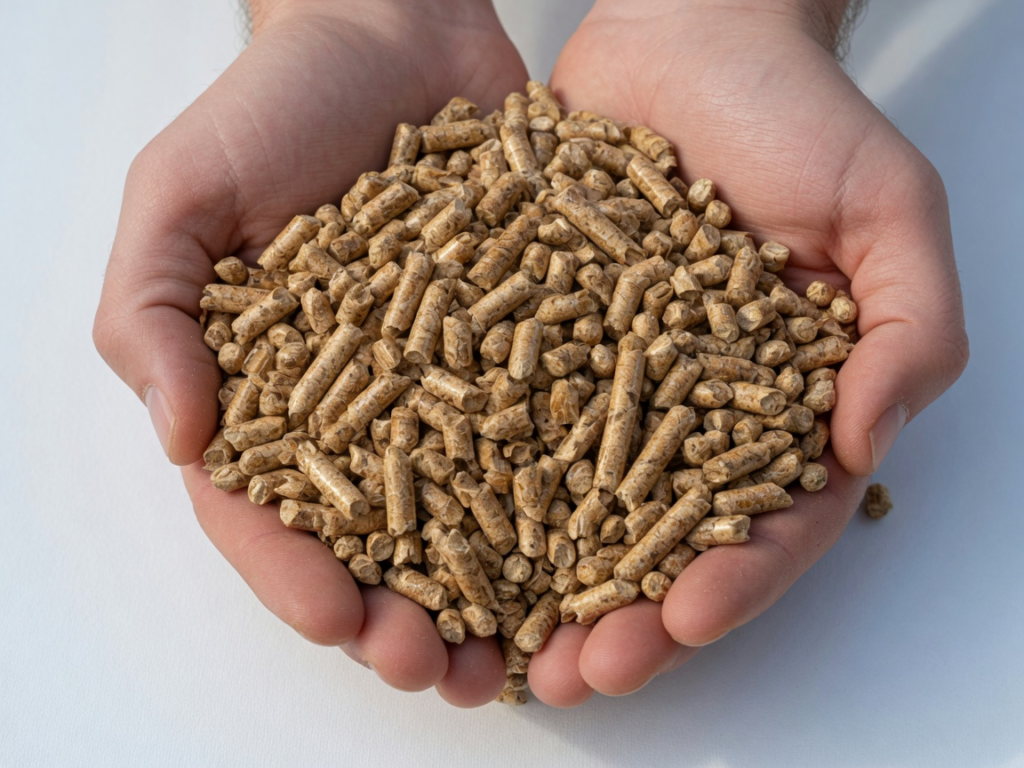
Buy premium wood pellets in bulk in the UK and Europe.
Wood pellets carry a calorific value of around 4.85 kWh/kg, meaning every kilogram you burn delivers 4.85 kilowatt hours of reliable heat energy. At Cambridgeshire Straw Pellets Limited, we supply certified ENplus A1 wood pellets and DINplus A1 wood pellets in bulk tonnage and full truck loads across the UK and Europe.
Our pellets meet the ENplus A1 grade, which enforces a strict ash content limit of 0.7%, moisture content of no more than 10%, and a mechanical durability rating of at least 97.5%. Whether you are heating a family home, running a commercial property, or managing an industrial facility, our wood pellets are sized and graded for consistent, clean combustion with minimal maintenance.
We also supply softwood wood pellets for buyers who need rapid ignition and high-temperature output. All orders are fulfilled by weight in tonnes or by full truck, making us a preferred partner for bulk buyers across Germany, France, the Netherlands, Belgium, and beyond.
Place your order directly through our shop or contact us for a bespoke quotation.
Why do wood species affect the calorific value of wood pellets?
Wood species determines lignin, cellulose, and resin content, which directly sets how much chemical energy one kilogram of pellets holds before any moisture or ash reduces it.
The energy content of wood pellets depends on the raw material’s lignin, cellulose, and hemicellulose composition.
Pine pellets and other coniferous species achieve a calorific value in the range of 4.8–5.3 kWh/kg (approximately 17–19 MJ/kg). Thanks to natural resin content and compact structure, these pellets are easy to ignite and quickly reach high temperatures.
Pellets from deciduous trees, such as oak or beech, have a slightly lower calorific value, usually 4.5–5.0 kWh/kg (approximately 16–18 MJ/kg). Deciduous wood is denser and ignites more slowly but provides long-lasting, stable combustion.
For most residential heating applications, softwood pellets win on ignition speed and peak temperature, while hardwood pellets win on burn duration. Our softwood wood pellets balance both qualities for everyday home heating.
How does moisture content lower the energy per kilogram?
Every extra percentage point of moisture in a wood pellet displaces combustible wood and forces the fire to spend energy evaporating water, reducing the useful heat delivered.
Moisture lowers the calorific value in two ways: every kilogram of water replaces a kilogram of wood, and the fire must spend energy evaporating it. That is why the A1 limit of 10% moisture matters so much.
Every extra percent of moisture cuts usable calorific value, which is why pellets are dried below 10%.
Moisture above that threshold also causes other problems. Moisture above 10% leads to lower combustion temperature, condensation formation in the chimney, corrosion of metal boiler parts, and pellet disintegration during storage.
To protect your investment after delivery, follow our guide on how to store pellets and firewood correctly.
How does ash content affect the best wood pellets for heating?
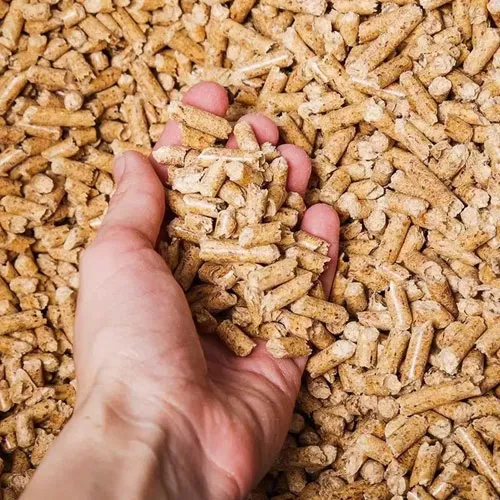
Ash is the non-combustible mineral fraction; the more ash a pellet contains, the less fuel mass per kilogram converts to heat, and the more frequently you must clean your appliance.
Ash is the non-combustible mineral fraction. The more ash, the less fuel per kilogram. Clean wood pellets sit under 1.5%; some agro-residues run higher.
In ENplus A1 pellets it is no more than 0.7%, while in regular pellets it can be 2–3%. The difference is colossal: ENplus A1 (0.7% ash) produces 35 kg of ash per tonne, while regular pellets (2.5% ash) produce 125 kg of ash, meaning 3.5 times more boiler cleanings and a higher risk of slag formation.
Our buy A1 wood pellets online product page shows the full certified specifications for every batch we supply.
What is ENplus A1 certification, and why does it matter when you buy wood pellets in the UK?
ENplus A1 is the highest European quality standard for residential wood pellets, guaranteeing calorific value above 16.5 MJ/kg, ash content below 0.7%, and moisture below 10%.
ENplus A1 is the highest quality wood pellet grade for residential boilers, characterised by ash content below 0.7% and high energy density.
Key facts to know: ENplus certification guarantees the quality of wood pellets at a global level; Grade A1 is the highest quality for households, A2 for larger installations; lower ash content (0.7% for A1) means cleaner combustion and less maintenance; and 80% of pellets sold in Europe are ENplus certified.
According to a 2025 European Pellet Council report, A1 pellets account for over 90% of the European residential market due to their strict mechanical durability requirements.
| Parameter | ENplus A1 | ENplus A2 | ENplus B |
|---|---|---|---|
| Calorific value (MJ/kg) | 16.5 min | 16.5 min | 16.5 min |
| Ash content | 0.7% max | 1.5% max | 2.0% max |
| Moisture content | 10% max | 10% max | 10% max |
| Mechanical durability | 97.5% min | 97.5% min | 96.5% min |
| Primary use | Residential | Larger installations | Industrial |
Source: EN ISO 17225-2 and European Pellet Council, 2025/2026.
For bulk orders of ENplus-certified fuel, visit our buying wood pellets in bulk guide or browse our DINplus A1 wood pellets for another premium certified option.
How does the wood pellet calorific value compare to other fuels?
One tonne of quality wood pellets delivers approximately 4,600–5,000 kWh, equivalent to around 480 litres of heating oil, 500 cubic metres of natural gas, or 1.2 tonnes of dry firewood.
Energy equivalent: 1 tonne of pellets is approximately equal to 480 litres of heating oil, 500 m³ of natural gas, 650 kg of imported coal, or 1.2 tonnes of dry firewood.
The calorific value of pellets is about 4.8 kWh per kg, compared to wood at about 4.0 kWh. Just 2 kg of wood pellets create the calorific value of one litre of heating oil, and they are considerably cheaper with the same performance.
| Fuel | Calorific value | Pollutants |
|---|---|---|
| Wood pellets (ENplus A1) | 4.6–5.0 kWh/kg | None |
| Heating oil | 10.18 kWh/litre | Sulphur |
| Wood chip | 3.5 kWh/kg | Low |
| Raw coal | ~5.8 kWh/kg | Sulphur |
| Dry firewood | ~4.0 kWh/kg | Low |
Sources: Woodco Energy, Brunner, EN ISO 17225-2, October 2026.
Wood pellets do not match oil on energy density per kilogram, but they produce no sulphur emissions, have a significantly lower carbon footprint, and, when bought in bulk, carry a very competitive cost per useful kWh. Compare our range on our shop page.
Where to order bulk wood pellets in the UK and Europe
We have supplied wood pellets, wood briquettes, sawdust, wood shavings, charcoal, wood chips, and firewood in bulk since our incorporation in 2009 (Company Registration No. 06928341). Our customers span the UK, France, Germany, the Netherlands, Belgium, and wider Europe.
For large-scale residential, commercial, or industrial requirements, buying wood pellets in bulk from us means you lock in certified quality, consistent calorific values, and competitive pricing per tonne. We fulfil orders by the tonne or by the truckload, and our logistics team handles cross-border delivery arrangements directly.
You may also find the following useful:
- Straw pellets vs wood pellets for a head-to-head comparison of two of our most popular product lines
- How much is a tonne of wood pellets? for current pricing guidance
- How to store pellets and firewood to protect your bulk purchase
- Straw pellet prices UK for alternative biomass options
“The calorific value of wood pellets is consistent and measurable. When you buy certified, you buy certainty.” — Cambridgeshire Straw Pellets Limited, established 2009
Key takeaways
- Wood pellet calorific value ranges from 4.6–5.0 kWh/kg (16.5–18 MJ/kg) under ENplus A1 certification.
- One tonne of quality pellets delivers 4,600–5,000 kWh, before appliance efficiency.
- Softwood pellets (pine, spruce) tend to sit at the top of the calorific range; hardwood pellets burn longer but slightly cooler.
- Moisture content below 10% and ash content below 0.7% (ENplus A1) are the two most important quality indicators to verify before purchasing.
- One tonne of wood pellets is broadly equivalent to 480 litres of heating oil in usable heat output.
- Always compare on net calorific value (NCV), not gross calorific value, as NCV reflects what your appliance actually delivers.
- Bulk buying from a certified supplier locks in consistent quality and lowers the cost per kWh significantly.
Frequently asked questions
What is the calorific value of wood pellets per kilogram?
Wood pellets have a very consistent calorific value of around 4.85 kWh/kg, meaning that a kilogram delivers 4.85 kilowatt hours of heat energy. Under the ENplus A1 standard the certified minimum is 4.6 kWh/kg (16.5 MJ/kg), with premium softwood pellets often reaching 5.0 kWh/kg.
Which wood pellets have the highest calorific value, softwood or hardwood?
Hardwoods generally exhibit higher calorific values (18–20 MJ/kg) due to their dense structure and elevated lignin content, and their low ash content (below 1%) further improves combustion efficiency. However, softwoods offer slightly lower energy values (16–18 MJ/kg) but burn faster due to higher resin content, and their higher volatile matter (75–80%) supports rapid ignition, which is ideal for residential heating.
How much energy does a tonne of wood pellets contain?
Typical A1 softwood pellets deliver 4.6–5.0 kWh/kg, so a tonne contains about 4,600–5,000 kWh, before appliance efficiency. For practical heating planning, use 4.8 kWh/kg as a reliable average for quality certified pellets.
How does moisture content affect wood pellet calorific value?
Moisture lowers the calorific value in two ways: every kilogram of water replaces a kilogram of wood, and the fire must spend energy evaporating it. Pellets with moisture above 10% also risk chimney condensation, corrosion, and structural breakdown in storage. Always check the moisture certificate before purchasing in bulk.
What is a good calorific value for wood pellets?
For wood pellets, 4,000 kcal/kg or above (GCV) is considered good. Always pair the calorific value figure with moisture and ash figures to get a complete picture of pellet quality. For residential use, ENplus A1 certification is the clearest assurance that all three parameters meet the required thresholds.
Are ENplus A1 wood pellets worth buying in bulk for UK and European buyers?
ENplus A1 pellets guarantee a minimum energy output of 4,600 kWh per tonne, ultra-low ash content below 0.7% (versus the ENplus A1 ceiling of 0.7%), and published independent laboratory test reports for full transparency. For bulk buyers heating large residential or commercial properties, the consistency in calorific value makes ENplus A1 pellets the most cost-predictable fuel choice available.
How does the calorific value of wood pellets compare to oil?
Wood pellets deliver 4.85 kWh/kg, oil delivers around 10.15 kWh/litre. Roughly 2.09 tonnes of wood pellets have the same calorific value as 1,000 litres of oil. However, wood pellets produce no sulphur emissions and carry a significantly lower carbon footprint per unit of useful heat.
References
- Doğa Pelet technical team (updated September 2026): Wood pellets have a net calorific value of at least 16.5 MJ/kg under ENplus A1, approximately 4.6 kWh or 3,940 kcal per kilogram. dogapelet.com.tr
- PeletLab (updated September 2026): When people talk about the “calorific value” of pellets, they usually mean the net calorific value, the amount of heat released by complete combustion of a unit mass of fuel when the water in the flue gas remains as vapour. peletlab.pl
- Duffield Timber: wood pellets carry a calorific value of 4.85 kWh/kg and a moisture content of 5–10%. duffieldtimber.com
- Woodco Energy: roughly 2.09 tonnes of wood pellets has the same calorific value as 1,000 litres of oil. woodco-energy.com
- European Pellet Council (2025 report): A1 pellets account for over 90% of the European residential market due to their strict mechanical durability requirements. woodbrezany.com
- Inflame Energy: ENplus A1 pellets (0.7% ash) produce 35 kg of ash per tonne, versus 125 kg from regular pellets at 2.5% ash, meaning 3.5 times more boiler cleanings with lower-grade fuel. inflame.eu
- Brunner (2026): the calorific value of pellets is about 4.8 kWh per kg versus wood at about 4.0 kWh; 2 kg of wood pellets create the calorific value of one litre of heating oil. brunner.com
Content produced by Cambridgeshire Straw Pellets Limited (cambridgeshirestrawpellets.com), incorporated 2009, Company Registration No. 06928341. All calorific value figures are sourced from independent technical references and ENplus certification data current as of October 2026.