Straw pellets vs wood pellets: which biomass fuel deserves your money?
The debate over straw pellets vs wood pellets confuses plenty of buyers, and the honest answer is that each fuel earns its place. Both are compressed biomass fuels made from plant matter, both burn in suitable appliances, and both count as renewable heat. The difference sits in the physics: energy density, ash behaviour and price per gigajoule. As a UK bulk fuel supplier trading since 2009, we move both fuels by the tonne and by the truckload, so we have no reason to flatter either one. This guide compares them on the numbers, using published research and certification standards rather than marketing claims.
Order bulk straw and wood pellets for sale across the UK and Europe.
We are Cambridgeshire Straw Pellets Limited, incorporated in 2009 and registered at Companies House under company number 06928341. From our Cambridgeshire base, we supply wood pellets, wood briquettes, charcoal, firewood, sawdust, wood shavings and wood chips in bulk, by the tonne or by the full truckload, to households, farms, retailers and industrial buyers across the UK and Europe.
Our certified range includes A1 wood pellets, DINplus A1 wood pellets and softwood wood pellets, each checked for moisture, ash and calorific value before dispatch. Request a quote through our contact page, browse the full shop, or read more about us.
What is the difference between straw pellets and wood pellets?
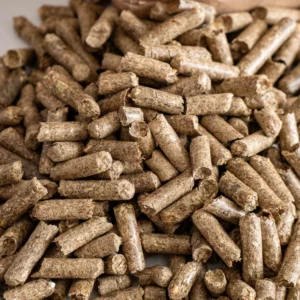
Straw pellets are compacted crop residue, wood pellets are densified sawdust, and the gaps are energy density, ash content, and boiler suitability.
Straw pellets are made from compacted cereal residue such as wheat and barley straw, material that would otherwise be ploughed back into the field. Wood pellets are made from densified sawdust, the clean offcuts of timber processing. The production method is the same; the chemistry is not. A review in Renewable and Sustainable Energy Reviews explains that straw can be a more attractive feedstock than wood because it arrives at the mill already dry and may need no artificial drying or cutting production energy (ScienceDirect). The same review warns that straw carries more mineral matter, which raises ash and corrosion risk in unsuitable boilers:
“Cereal residues tend to contain higher nitrogen, sulphur, chlorine and potassium and thus ash contents, which can lead to slagging and corrosion of boilers.”
Which fuel burns hotter: straw pellets or wood pellets?
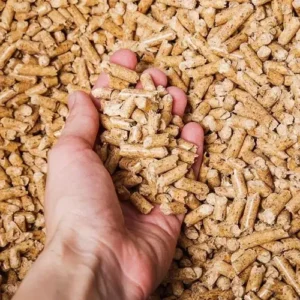
Wood pellets burn hotter and cleaner: A1 wood fuel delivers about 18 to 20 MJ/kg with under 0.7% ash, versus 16 to 18 MJ/kg and 4 to 7% ash for straw.
How does calorific value compare?
Wood pellets hold the edge. Field measurements put wood pellets at roughly 18 to 20 MJ/kg, against 16 to 18 MJ/kg for straw, with wheat straw pellets at about 16 MJ/kg on a lower heating value basis (Pelwod). That gap matters in a domestic stove, where every kilogram feeds a small firebox. In an industrial burner fed by the tonne, the difference narrows against straw’s lower fuel cost.
What about ash content and ash melting?
Ash Content is where the two fuel companies parted company. ENplus A1 wood pellets must produce no more than 0.7% ash and stay below 10% moisture under the ENplus quality scheme. Cereal straws leave 4 to 7% ash by weight (Pelwod), which means more frequent de-ashing.
Straw ash also melts differently: one study in the journal Fire recorded flow temperatures above 1300°C for straw ash across all tested atmospheres (MDPI), while tests in an 18 kW underfeed burner measured wheat straw ash deformation at about 797°C (ScienceDirect), so appliance design decides if the leftover is fine ash or clinker. A 2024 analysis of 28 certified A1 assortments in biomass conversion and biorefinery found bulk densities between 614 and 710 kg/m³ and moisture between 3.3 and 9.4%, all within specification (Springer).
The table below summarises the straw pellets vs wood pellets comparison at a glance.
| Property | Straw pellets | Wood pellets (ENplus A1) |
|---|---|---|
| Raw material | Compacted cereal straw (wheat, barley) | Densified sawdust and timber offcuts |
| Calorific value | 16 to 18 MJ/kg | 18 to 20 MJ/kg |
| Ash content | 4 to 7% | 0.7% maximum |
| Moisture limit | Below 10% | Below 10% |
| Bulk density | Lower, crop-dependent | 614 to 710 kg/m³ in tested samples |
| Ash melting risk | Higher, appliance-dependent | Low |
| Certification | No equivalent domestic scheme | ENplus A1 and DINplus certified |
| Best use | Industrial heat, farms, horse bedding | Pellet stoves, domestic and commercial boilers |
| Price band | Lower per tonne | Higher per tonne, stronger per gigajoule |
Why are straw pellets cheaper than wood pellets?
Straw pellets cost less because straw is a plentiful field by-product that often needs no drying, cutting, or pellet production energy and cost.
Price follows processing energy. Straw arrives at the mill already dry, so producers skip the drum driers that consume a large share of the energy budget at wood pellet plants. Feedstock is abundant too: straw is a seasonal by-product of grain farming, traded at a fraction of timber cost. The trade-off is combustion behaviour. Potassium and chlorine in straw raise the corrosion risk in heat exchangers, which is why agricultural and industrial buyers accept more maintenance in exchange for a lower bill per tonne. Burn it in the right appliance, at the right temperature, and straw pellets are an honest, low-cost heat source, and the ash can go back onto the garden as a fertiliser.
Where can you buy the best wood pellets in bulk in the UK?
You can order bulk wood pellets by the tonne or full truckload from Cambridgeshire Straw Pellets, with haulage across the UK and wider Europe.
The market context is worth knowing. The UK is the largest global consumer of imported wood pellets, with 2025 imports forecast to exceed 9.6 million metric tonnes, and biomass provided about 7% of total UK energy production in 2024 (USDA Foreign Agricultural Service). Analysts project the UK biomass pellets market to grow from $230.41 million in 2025 to $393.66 million by 2035 (Market Research Future).
Demand like that rewards buyers who secure bulk supply early. We stock A1 wood pellets, DINplus A1 wood pellets and softwood wood pellets in pallet and tonne quantities, plus Nestro briquettes, Pini Kay briquettes and RUF briquettes for customers who want a denser log replacement. Our guide to buying wood pellets in bulk explains how we quote by tonne or truckload.
How should you store straw and wood pellets?
Store both fuels dry and off the ground, below 10% moisture, in a ventilated shed, and they keep their full calorific value for months.
Moisture is the only real enemy. Both fuels leave the mill below the 10% ceiling set by the ENplus standard, and the 2024 Springer analysis found certified samples ranging from 3.3 to 9.4% moisture (Springer). Keep bags stacked off concrete, away from damp walls, and leave a small air gap for ventilation. Loose bulk deliveries should go into a dry, sealed silo or shed. Our full pellet and firewood storage guide covers the checklist step by step.
Which fuel should you choose for your boiler?
Pick wood pellets for homes and small boilers and straw pellets for industrial burners, farms and bedding, where low price offsets higher ash.
For a domestic pellet stove or boiler, order certified wood pellets UK buyers trust; low ash keeps weekly maintenance to minutes and protects the appliance warranty. For farm heat, grain drying, industrial boilers and horse bedding, straw pellets for sale win on cost. If you heat a workshop or business, consider wood briquettes or birch firewood alongside pellets for flexible burning. Still unsure? Send us the appliance model through our contact page, and we will match the fuel to it, or read the answers on our FAQ page.
Key takeaways
- Wood pellets: higher calorific value (18 to 20 MJ/kg), under 0.7% ash, certified to ENplus A1, the best choice for homes.
- Straw pellets: cheaper, 16 to 18 MJ/kg, 4 to 7% ash, the best choice for industry, farms and bedding.
- Both fuels must stay below 10% moisture in storage.
- Match the fuel to the appliance; burning straw in a domestic stove risks clinker and lost warranty coverage.
- Buying in bulk by the tonne or truckload cuts the unit cost of either fuel.
What do buyers ask about straw pellets vs wood pellets?
Can you burn straw pellets in a wood pellet stove?
Not as a rule. Domestic stoves are certified for wood pellets only; straw’s higher ash and potassium can form clinker and damage the burner. Check your manual or ask us before you order.
Are straw pellets or wood pellets better for horse bedding?
Straw pellets. They expand into soft, absorbent bedding when dampened and cost less per tonne, while wood shavings remain a popular alternative, and we supply both.
How much ash do straw pellets leave compared with wood pellets?
About 4 to 7% by weight for cereal straw against under 1% for certified wood pellets, so expect more frequent de-ashing with straw.
Do wood pellets expire or lose quality in storage?
They are kept for years in a dry store. Moisture is the only risk; below 10% and sealed, pellets hold their calorific value season after season.
Which fuel is more sustainable: straw pellets or wood pellets?
Both are renewable biomass fuels. Straw pellets use a field by-product with minimal processing energy, while certified wood pellets come from forestry residues. Neither adds fossil carbon, so the honest choice depends on your appliance and budget.
References
- Quality range of ENplus A1 certified wood pellets and their combustion behaviour in residential pellet stoves and pellet boilers, Biomass Conversion and Biorefinery, Springer, 2024
- Factors affecting wood, energy grass and straw pellet durability: a review, Renewable and Sustainable Energy Reviews, ScienceDirect
- Analysis of ash melting temperatures of agricultural pellets detected during different conditions, Fire, MDPI, 2023
- Evaluating the combustion of various biomass pellets in a small heat source with an underfeed pellet burner, ScienceDirect, 2024
- Wood Pellets Annual, United Kingdom, USDA Foreign Agricultural Service, 2025
- UK biomass pellets market size, share and analysis report 2035, Market Research Future
- Heating with pellets: cost, efficiency and agricultural benefit, Pelwod
straw pellets vs wood pellets, buy wood pellets UK, straw pellets for sale, bulk wood pellets Europe, ENplus A1 wood pellets
Page last updated: 11 October 2026