What are the pros and cons of using wood pellets for horse bedding?
Wood pellets for horse bedding offer exceptional absorbency, low dust, and strong odour control, making them one of the most practical choices for modern equestrian yards across the UK. At Cambridgeshire Straw Pellets Limited, we have been supplying bulk wood pellets to stables, livery yards, and equestrian centres since 2009, and we understand exactly what horse owners need from a bedding product. This guide walks you through the real advantages and the honest limitations of choosing wood pellets for your stable, backed by facts, so you can make a confident, informed decision.
What are wood pellets for horse bedding?
Wood pellets for horse bedding are a compressed, high-density sawdust product that transforms into soft, absorbent bedding when water is applied.
Wood pellets are compressed sawdust that expands with the addition of water, transforming into bedding. Because the product starts as a small, dense pellet rather than a fine shaving or chopped straw, there is very little loose fibre to become airborne when horses move around the stable or during mucking out. Lignin, a natural binding agent found in wood fibre, holds pellets together in their compressed form, which means each bag contains significantly more usable bedding material than a comparable bale of shavings. The result is a firmer, more consistent, and hygienically superior base for your horse’s stable floor.
It is important to note that although all wood pellets are made from compressed wood, not all wood pellets are suitable for use as horse bedding. Wood pellets made for heating are often made from waste wood and different wood species, whereas bedding pellets are designed to provide high absorbency, low dust, and longevity.
Buy wood pellets for horse bedding in bulk.
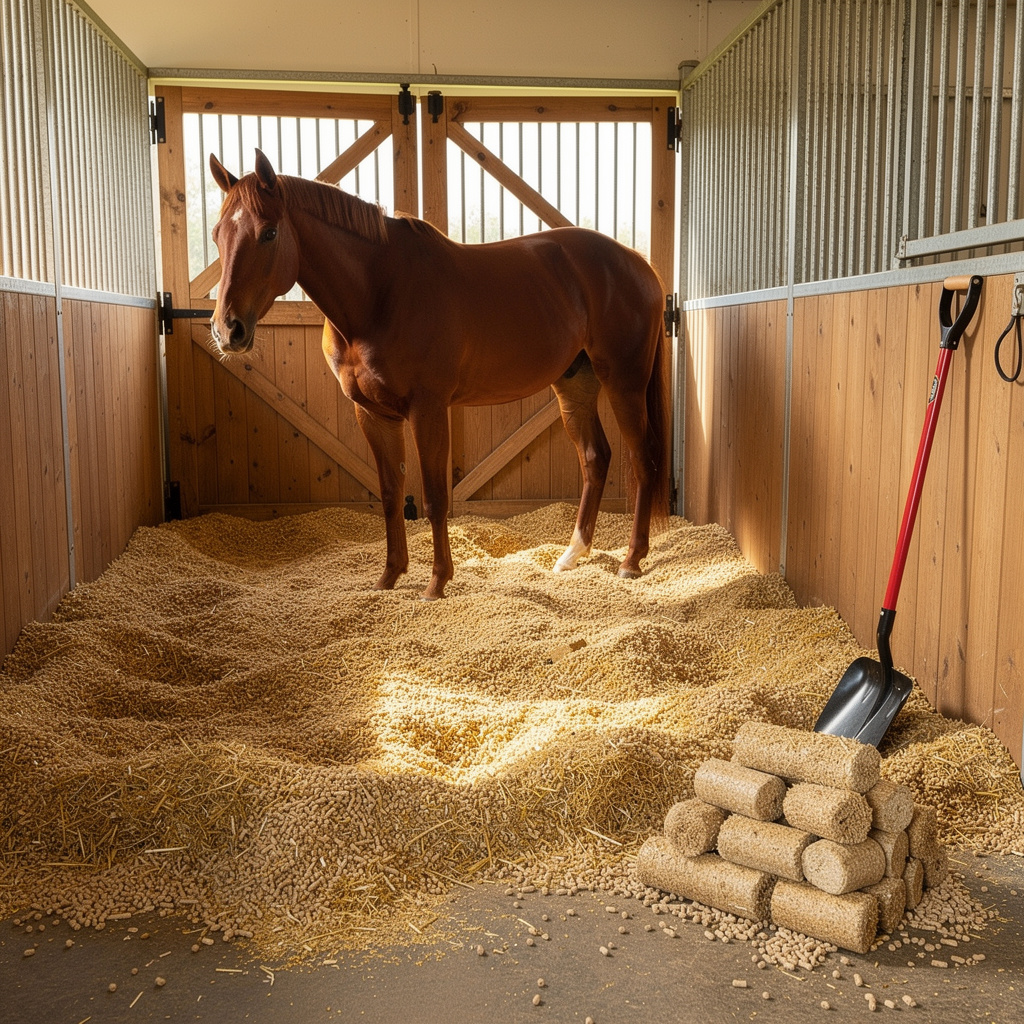
At Cambridgeshire Straw Pellets Limited, we supply premium-grade wood pellets for horse bedding in bulk (by the tonne or full truck), designed to give your horses a clean, dry, and low-dust stable environment all year round. Our ENplus A1 certified softwood pellets are manufactured under strict quality controls, producing minimal dust, high moisture absorption, and consistent pellet size for reliable performance in any stable environment.
Wood pellets are compressed from pure softwood fibres and expand on contact with moisture into a soft, cushioned bed that locks in liquid quickly, keeping the surface dry and the air in your stable smelling fresh. Unlike loose shavings or straw, our pellets are compact to store, easy to muck out, and significantly reduce your muck heap volume over time.
We supply horse yards, equestrian centres, livery stables, and individual horse owners across the UK and Europe. Ordering in bulk means a lower cost per tonne, and our reliable delivery logistics mean your bedding arrives when you need it. Buy wood pellets in the UK from a trusted British supplier incorporated in 2009.
Key product highlights:
- Superior absorbency: absorbs up to three times the pellet’s own weight in liquid
- Low dust: suitable for horses with respiratory sensitivities or equine asthma
- Odour control: natural wood properties neutralise ammonia build-up
- Compact storage: bags are easy to handle and stack compared to baled shavings
- Environmentally sound: biodegradable and compostable
- Bulk ordering: available by the tonne or truck for yards of any size
Order wood pellets in bulk today and give your horses the bedding they deserve.
Why buy wood pellets for horse bedding? The key benefits
Superior absorbency that keeps stalls dry
Wood pellets can absorb nine times more liquid than regular shavings, making them ideal for deep-litter beds. One 15 kg bag can absorb as much as 11 gallons of water. This level of moisture retention is particularly valuable in busy yards where horses spend long periods stabled, as it reduces the frequency of full bed changes and keeps the stable floor genuinely dry.
Pellets soak up moisture quickly and efficiently, meaning stables stay dry and reduce the risk of bacterial growth or hoof issues.
Best horse bedding for respiratory health: low dust performance
Wood pellets are your best choice for horse bedding with minimal dust. Dust can bother animals, as it irritates their respiratory system, and because wood pellet bedding is compact and splits apart to absorb moisture, it tends to be without dust, providing a clean-air environment for your horse.
In contrast to sawdust and straw, the dust content of quality wood pellets is carefully controlled during manufacturing. This attribute proves especially beneficial for horses affected by COPD, ensuring their year-round well-being and comfort.
If the horse has heaves or other respiratory issues, wood pellets, an absorbent bedding with low dust, mould, and foreign object count, will be the best choice. The greater the bedding’s absorbency, the lower the ammonia level will be in your barn, and breathing ammonia can damage lung tissue in both you and your horse.
Hygiene and natural antiseptic properties
From a veterinary perspective, one of the major benefits of wood pellets is that they are heated to a high temperature during manufacture, meaning any bugs are killed off. Pellets made with pine and spruce fibres contain natural agents which help remove the smell of ammonia from urine. Overall, pellets work as a natural antiseptic and produce a light, fluffy bedding for horses and other livestock.
Time-saving and easier mucking out
You can see the wet patches in a wood pellet bed easily and can remove them without having to take the whole bed apart, which reduces mucking-out time. You only remove the wet areas, leaving the clean bedding in place. This targeted approach means less wasted bedding and a smaller muck heap over time.
Cost savings when buying wood pellets in bulk
Most wood pellet companies offer the option of buying in bulk, and provided you have somewhere to store it, this is a good way of saving money on your horse costs. Buying by the tonne, you could be paying under £5 for a bag of wood pellets, including VAT and delivery, which is significantly cheaper than most brands of shavings.
Reduced waste and faster muck-out can offset the higher upfront price over time. At Cambridgeshire Straw Pellets Limited, we make buying wood pellets in bulk straightforward for yards of all sizes, with orders available by the tonne or full truck.
Compact storage and environmental benefits
Bags of pre-compressed pellets are dense and take up far less storage space than an equivalent volume of baled shavings, a real consideration if your feed store or muck-heap capacity is limited. Wood pellets are biodegradable and compost easily, making them a solid choice for eco-conscious horse owners.
What are the cons of using wood pellets for horse bedding?
A fair assessment requires honesty. Wood pellets for horse bedding are not without limitations, and every horse owner should understand the trade-offs before committing.
Initial preparation takes time.
They can be time-consuming to lay, as they need wetting prior to use, and they can be slippery when still dry. The expansion of an entire bag of pellets can take anywhere from 20 minutes to upwards of an hour. However, using warm water instead of cold will speed up the expansion time.
Slippery surface when not properly activated
Activating the wood pellets can get messy, and soaking them adds time to laying beds. With a tendency to be slippery when wet, this can be a hazard that can cause accidents. Ensure they are adequately wet to avoid slipperiness. Mixing with wood shavings can significantly improve comfort.
Higher upfront cost per bag
Wood pellets are generally more expensive than shavings, especially for horse-specific, high-quality pellets. Bags of pellets can be more expensive per bag; however, since you will be using fewer amounts than shavings, the cost can be less over time even though the initial purchase can be more expensive.
Firmness before full activation
Pellets need moisture to break down and can take some time to activate. For some horses, this can create an uncomfortable environment for a while until the pellets start to break down. Blending a layer of pine wood shavings on top during the bed-in period can resolve this effectively.
Quality varies between suppliers.
As wood pellets are not all manufactured in the same way, they contain varying levels of dust. One of the key factors is the raw material used. Pellets made from clean virgin wood typically produce less dust than products manufactured from lower-grade wood, mixed wood sources, bark, and sawdust. Always choose ENplus A1-certified pellets from a trusted, traceable supplier.
Cold climate challenges
In colder climates during winter, you run the risk of the water freezing before the pellets are completely expanded. In an extremely dry climate, they can become dustier as they are stepped on if not absorbing moisture. Storing pellets indoors and using warm water for activation resolves this in most UK and European yard conditions.
Wood pellets vs other horse bedding: a comparison table
| Feature | Wood pellets | Wood shavings | Straw |
|---|---|---|---|
| Absorbency | Very high (up to 9x shavings) | Moderate | Low |
| Dust level | Very low (if ENplus A1 certified) | Low to moderate | High |
| Odour control | Excellent | Good | Poor |
| Initial cost per bag | Higher | Lower | Lowest |
| Long-term cost | Lower (less waste) | Moderate | Higher (more frequent changes) |
| Mucking out ease | Very easy (spot clean) | Moderate | Time-consuming |
| Setup time | Requires wetting and activation | Ready to use | Ready to use |
| Muck heap volume | Significantly smaller | Moderate | Large |
| Biodegradable | Yes. | Yes. | Yes. |
| Suitable for respiratory issues | Yes. | Moderate | No |
| Storage space needed | Small (compact bags) | Moderate (bales) | Large (bales) |
| Comfort when dry | Firm (needs activation) | Soft | Very soft |
| Best for | High-moisture stalls, respiratory horses | General use | Foam, soft beds |
How to use wood pellets for horse bedding correctly
Getting the setup right from the start means your horse benefits fully from the product’s properties.
- Lay the base layer: spread bags of pellets across the stable floor to your desired depth. For a standard 12 x 12 stable, six to eight 18 kg bags are recommended as a starting depth.
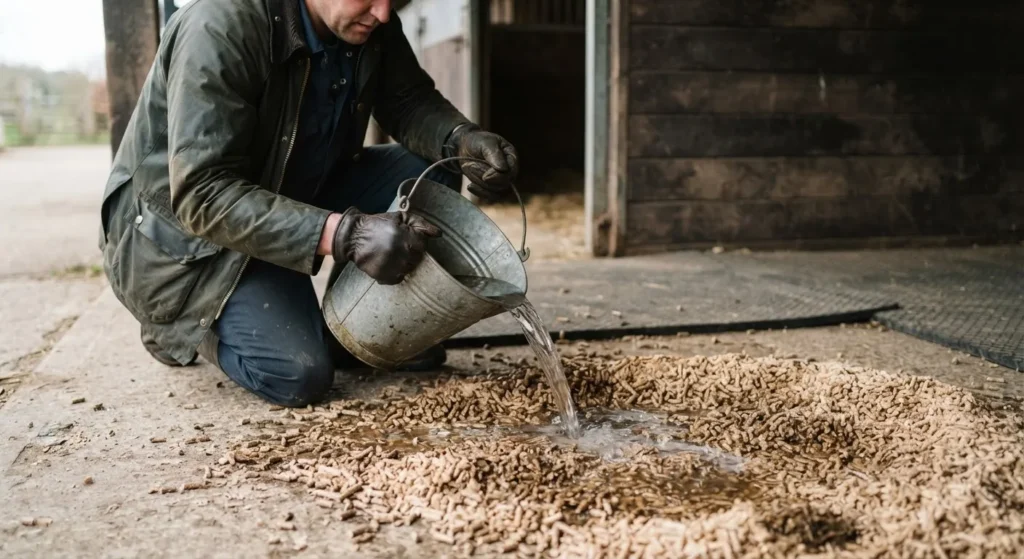
- Activate with water: when setting up a new bed, it is recommended that the pellets are activated with a little clean water before use. For an 18 kg bag, 5 litres of water is recommended.
- Allow time to expand: leave the pellets to absorb and break down for at least 20 to 30 minutes before allowing the horse in.
- Fluff the bed: use a fork to work the expanded pellets into an even, cushioned layer.
- Daily maintenance: spot-remove wet patches each day using a shavings fork. The dry pellets underneath can remain in place, reducing waste considerably.
- Top up as needed: add fresh bags on a rotation basis. Pellets are only 8% moisture and will soak up over three times their weight in water.
“It is much more cost effective as the muck heap takes much longer to grow,” notes leading show horse producer Jayne Ross, who beds her horses on soaked wood pellets and mucks out properly every day.
You can also compare wood pellets with straw pellets as an alternative option on our detailed guide: straw pellets vs wood pellets.
Which horses benefit most from wood pellet bedding?
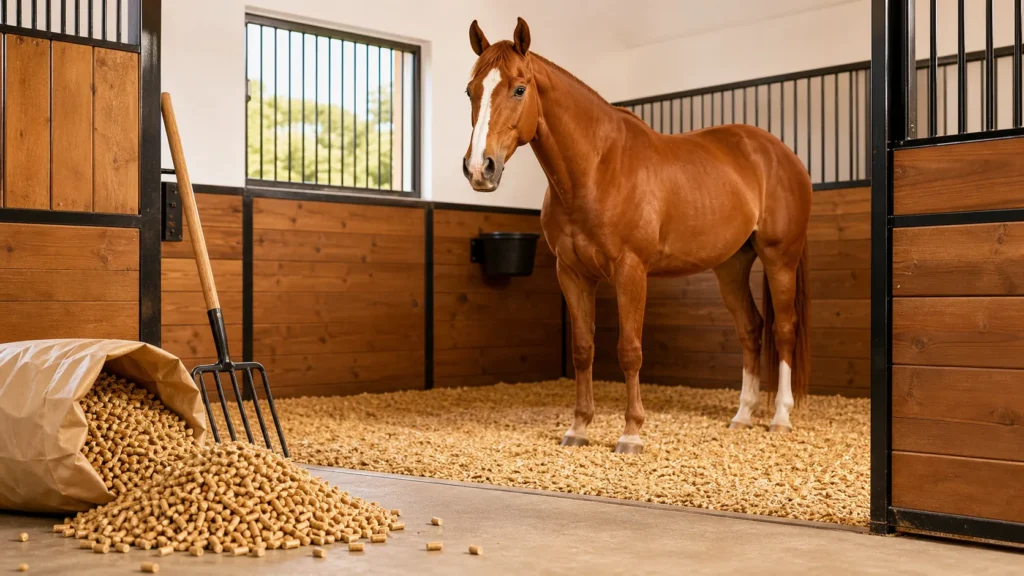
Wood pellet bedding is particularly well suited to:
- Horses with equine asthma or COPD, where a low-dust environment is critical
- Heavy wetters, where standard shavings fail to absorb quickly enough
- Competition horses, where hygiene and hoof health are a priority
- Yards with limited storage space, where compact bags make a practical difference
- Eco-conscious owners, who want a biodegradable, sustainable bedding choice
For horses that are prone to eating their bedding, wood pellets are a great bedding type as horses that eat their beds are far less likely to consume them. However, a horse should not eat wood pellets used for bedding, even when the pellets are manufactured specifically for equine use. Bedding pellets are normally moistened so they expand into a soft bed, but dry or partially expanded pellets may still attract some horses. Remove access and contact your veterinarian for guidance if your horse consumes a large amount.
If you manage horses with specific sensitivities, also read our resource on straw pellets for horse bedding for a broader comparison of natural bedding options.
Key takeaways
- Wood pellets for horse bedding are among the most absorbent bedding options available, absorbing up to nine times more liquid than regular shavings
- They are low in dust, making them the preferred choice for horses with respiratory conditions
- ENplus A1 certified pellets from a reputable supplier are essential; quality varies significantly between brands
- The upfront cost per bag is higher, but bulk purchasing and reduced waste lower the long-term cost considerably
- Setup requires water and time, but daily mucking out becomes faster and more efficient once the bed is established
- Pellets can be slippery when dry: always activate properly before use
- Buying in bulk by the tonne or truck offers the best value for livery yards and equestrian centres
- Buying wood pellets in bulk from Cambridgeshire Straw Pellets Limited gives you reliable supply, traceable quality, and competitive pricing
Buy wood pellets for horse bedding
Are wood pellets good for horse bedding?
Wood pellets are highly absorbent, low-dust, and odour-controlling, making them one of the best modern horse bedding options available in the UK.
Horse bedding pellets are an increasingly popular choice for horse owners and stable managers. They are eco-friendly, cost-effective, and deliver clear benefits such as absorbency, odour control, and reduced dust. As a result, they create a healthier and more comfortable stable environment.
How many bags of wood pellets do I need for a horse stable?
A standard 12 x 12 stable requires six to eight 18 kg bags to establish a bed of the correct minimum depth.
For a typical 12 x 12 stable you will need six to eight bags, assuming the bags are 18 kg. It is easy to increase the depth and size of the bed by adding bags.
Do wood pellets need to be soaked before use in a horse stable?
Yes. Wood pellets must be activated with water before use to expand into a soft bed and to prevent them from being slippery underfoot.
When setting up a new bed it is recommended that the pellets are activated with a little clean water before use. For an 18 kg bag, 5 litres of water is recommended. Some pellets will still be whole and will continue to break down as the horse uses the bed. Pellets are only 8% moisture and will soak up over three times their weight in water.
Are wood pellets better than straw for horse bedding?
Wood pellets outperform straw on absorbency, dust levels, and odour control, though straw offers a softer initial surface and a lower upfront cost.
Wood pellets are known for their superior absorbency, which helps keep stalls drier and reduces ammonia odours. When properly moistened, they create a dust-free environment, which is beneficial for horses with respiratory issues. Pellets expand when wet, making them easy to spread and clean, which can reduce labour time and bedding waste. Read our detailed guide on straw pellets for horse bedding for a full comparison.
Can I buy wood pellets for horse bedding in bulk?
Yes. Bulk purchasing by the tonne or truck is available and reduces the cost per bag significantly for larger yards and equestrian centres.
Most wood pellet companies offer the option of buying in bulk, and provided you have somewhere to store it and have the capital up front, this is a good way of saving money on your horse costs. At Cambridgeshire Straw Pellets Limited, we supply wood pellets in bulk by tonne or truck across the UK and into Europe, with reliable logistics and traceable ENplus A1 quality.
What type of wood pellets are safest for horse bedding?
Softwood pellets certified to ENplus A1 standard, made from virgin wood with no additives, are the safest and most effective choice for horse bedding.
Pellets made from pure softwood fibres do not cause hoof-heating tannic acids, and softwood bedding pellets do not contain any woody material salvaged from urban or treated woods or used lumber and construction materials from building sites, which can seriously harm an animal because of unknown chemical contaminants and toxins. Pellets made from pure pine sawdust with no additives, such as ENplus A1 certified 6mm pellets, are a safer starting point for bedding use than an unbranded or uncertified pellet of unknown origin, precisely because the certification verifies what is and what is not in the pellet.
References
- Horse & Hound: Wood pellet horse bedding pros and cons
- Your Horse: Horse bedding guide, the pros and cons of different types
- Just Horse Riders: Shavings vs wood pellets for horse bedding
- Open Equine: What are the benefits of wood pellet bedding?
- DB Horse Stable: A guide to horse stable bedding
- Pelet Poltarex: Wood pellets for horse bedding, a safe complete 2026 guide
- Silva Bed: Pine pellet horse bedding, the complete guide for horse owners
wood pellets for horse bedding, buy wood pellets UK, best horse bedding pellets, horse bedding pellets bulk, wood pellet bedding pros and cons